
Photo: extinctionrebellion_bordeaux
Dear rebel,
Many think of Extinction Rebellion as being just about protests where people get arrested, but there is so much more to this movement. Lots of very active volunteers work behind the scenes keeping the movement going in countries all over the world. Whether you’re a protester, an organizer, a poster on social media, a financial supporter, or someone who shares our goals and helps spread the word, you matter. Our movement is a big tent, and we are grateful you’re here with us.
This newsletter is brought to you by XR Global Support, a worldwide network of rebels who help our movement grow and need money to continue this crucial work.
XR GLOBAL CLIMATE JUSTICE CAMPAIGN
Action Highlights
May 2026 | XR Roma
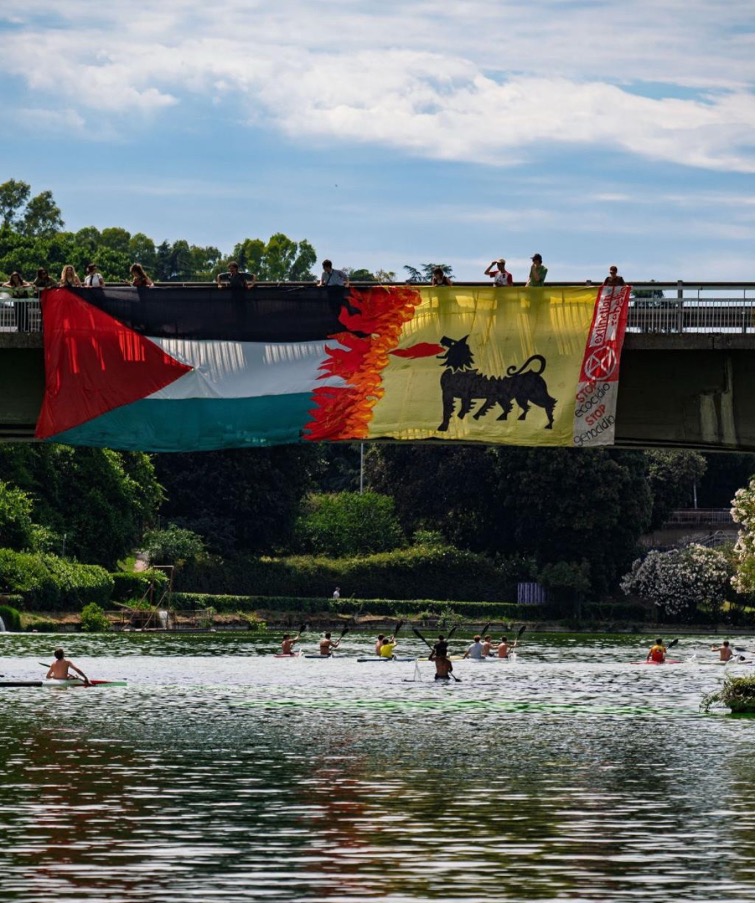
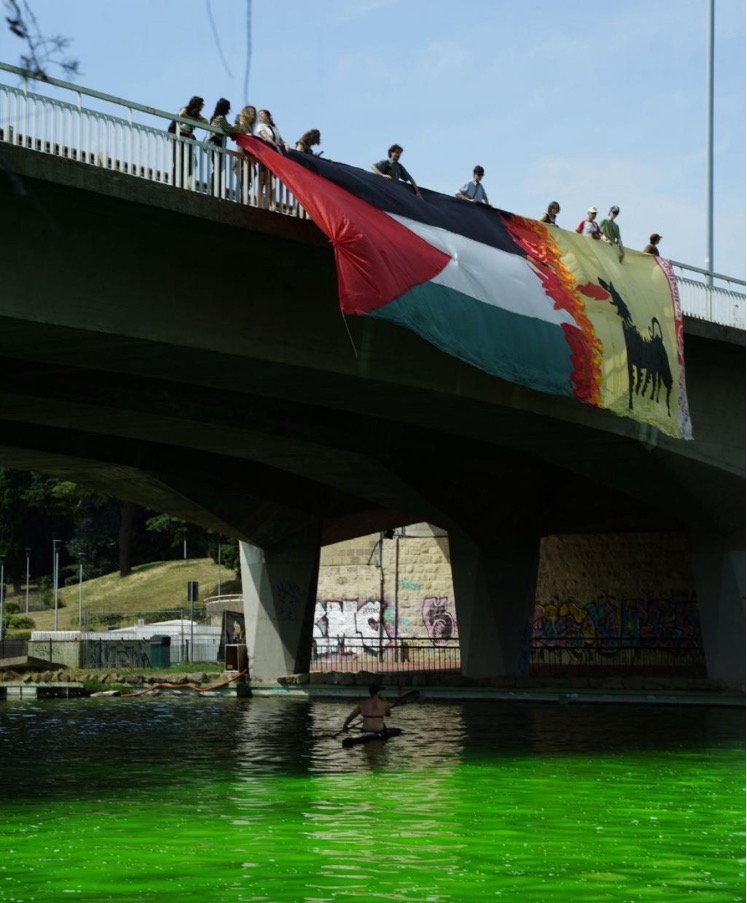
Photos: @XR Roma, @XR Parma and @XR Italia
As part of the General Strike against the economy of war, Extinction Rebellion Roma, in collaboration with Extinction Rebellion Parma and Extinction Rebellion Italia, staged a symbolic direct action in May 2026 at Ente Nazionale Idrocarburi (ENI), the Italian multinational energy headquarters, colouring the waters of the European Union lake green and unveiling a large banner depicting the company’s logo burning the Palestinian flag. The action sought to highlight the links between fossil fuel extraction, militarism, and environmental destruction, drawing attention to ENI’s partnership with Delek, a company identified as a major fuel supplier to the Israeli military. Activists used the action to spotlight ENI’s broader environmental and social impacts, citing its operations in communities across the world that have experienced pollution, ecological degradation, and associated health concerns. The protest also emphasised the role of major fossil fuel corporations in driving greenhouse gas emissions and contributing to the climate crisis.
The demonstration marked the beginning of Spring Democracy, an international wave of mobilisation that will see climate justice and anti-militarist movements across Europe take coordinated action over the coming month. Participants argued that environmental destruction, armed conflict, and social injustice are interconnected outcomes of an economic model based on fossil fuel dependency, resource extraction, and the pursuit of endless growth. Through this action, XR called for greater accountability from corporations profiting from environmental harm and conflict, while urging governments and communities to support a transition towards peace, climate justice, and more equitable economic systems.

Photo: @extinctionrebellion_bordeaux
May 2026 | XR Bordeaux
Extinction Rebellion Bordeaux marked the start of Pride Month with a loud and colourful parade that celebrated our ecological, queer, and antifascist movement. See more photos @extinctionrebellion_bordeaux
Must Reads
Criminalisation of climate protesters in UK is counterproductive, research finds - The Guardian
A study of 1,375 climate activists found that arrests, fines, and jail terms actually increase activists' determination to take direct action. Rather than deterring protest, stricter legal measures intensify grievances and encourage more disruptive forms of action. The anonymous survey, circulated amongst the XR mailing list, argues that states and governments are focusing on punishing dissent rather than addressing climate issues and recommends a presumption against criminalising climate protest, as punishment can be seen as incompatible with liberal democracy. This article goes beyond climate activism to ask a bigger question: what happens when governments criminalise dissent on issues that affect us all? It offers evidence that crackdowns backfire, and at a time when new laws are quietly reshaping what protest is even legal, it gives you the facts to form your own informed views.
Patagonia sues drag queen Pattie Gonia for trademark infringement- The Guardian
Patagonia has filed a trademark infringement lawsuit against Pattie Gonia, an environmentalist drag queen who has raised nearly $4 million for climate nonprofits. The lawsuit centres on Pattie Gonia’s September 2025 trademark application for the "Pattie Gonia" name, which Patagonia claims poses a long-term threat to its brand by overlapping with its own clothing and environmental advocacy work. The dispute went public in May when Pattie Gonia posted on Instagram accusing Patagonia of trying to "erase an activist," to which Patagonia responded with a list of demands: withdraw all trademark applications, stop using their logos, and stop selling merchandise as Pattie Gonia. This is where it gets uncomfortable for Patagonia. The brand has built its entire identity around environmental activism, sustainability, and doing good in the world, yet here it is, deploying legal resources against a climate activist with over two million followers who has called the suit "a betrayal of the company's core mission." Suing a queer climate activist and draining funds meant for the planet, while claiming to care about the planet, is exactly the kind of contradiction that lessens trust in corporate environmentalism.
This Month's Suggested Action
We know not everyone can jump in on an XR action, but in today's world, emailing government officials and recycling doesn't feel like enough. So we like to suggest steps people can take to get involved with activism locally.
Today we're talking about rivers and streams.
First, find a river or stream in your area and figure out where it goes, from where the headwaters rise to where the stream enters a larger river, lake, or the sea. Next, visit as much of the stream in person as you can. How wild is it? How clean is it? Do people use it for recreation? Irrigation? Are parts of it channelized or paved over? What animals live in or near it? Depending on where you live, your stream or river might only have water part of the year. It still counts.
Now, adopt the river/stream. Doing a trash pick-up is a good way to start. Get friends to help, if you can, and plan to do it at least once a year. Maybe your trash pick-up will evolve into a huge community tradition with hundreds of volunteers working along miles of river. Maybe you'll discover some other threat to your river that you can do something about. Maybe you can get involved with a citizen-science project or start teaching others about your river and its issues. Or maybe you'll just visit your river sometimes and pick up trash once a year. Where you go with the project really depends on your interests, abilities, and resources, which may be very different from someone else's.
The important thing is to find your river.
Book Review: What We Can Know by Ian McKewan
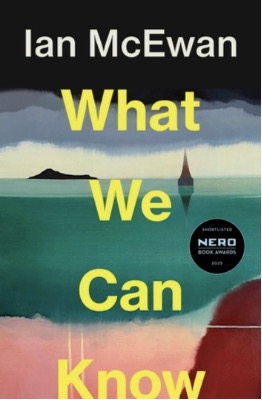
Ian McKewan is a prolific English novelist who is well-known for books like Atonement and The Children Act, both of which have been made into critically acclaimed films. Now, McKewan is confronting the climate crisis. He approaches it from the POV of what he knows and lives – writers in England and people studying English writers. The first half of the book is set in the future when the full impacts of the climate crisis have become manifest and have significantly altered the geography and reality of daily life in the United Kingdom. The second half circles back to somewhere around now when some people are trying to push for change but most are too wrapped up in their own lives and loves to grasp what is at stake. The title is almost a question - can we ever know what really happened in the past? Can we ever really know what other people’s lives were really like? Despite its weighty topics, What We Can Know is a highly readable novel and might also be a unique way to slide the climate crisis into the headspace of anyone you know who thinks ecological concerns aren’t their problem.
Positive Reads
Two months in, the Iran war has changed the global energy system forever - Grist
The outbreak of war in Iran and the blockade of the strategic Strait of Hormuz have cut off 20% of the world’s oil and liquefied natural gas (LNG), triggering a historic energy crisis. However, because modern renewable alternatives are now cheap and viable, this disruption is providing the ultimate catalyst to permanently break the dominance of fossil fuels and accelerate a cleaner future. While vulnerable oil and natural gas supplies are declining, clean energy alternatives like solar power are surging to record breaking adoption rates worldwide. Even as countries temporarily utilise legacy coal plants to keep grids stable during the transition, the crisis is ultimately fast tracking a historic, permanent shift toward secure, self reliant, and zero carbon energy independence. Grist Newsletter shares more information on the world’s pathway to alternative energy systems.
Solutions Desk - Environmental Journalism and Education - Mongabay
Although solutions journalism, which focuses on the responses to issues and not just the problems, has been around for over 25 years, it isn’t very common in the climate world. Sometimes accused of being “feel good” puff pieces, this kind of journalism is very important as people try to understand how to have maximum impact with their climate efforts globally. Mongabay, known for its climate reporting, now has a Solutions Desk which highlights the results, positive and negative, of real climate projects around the world.
Quick Watch
Watch The Business of Adapting to Flood Risk - Bloomberg
Greenhouse gases blanketing the earth are warming our climate, leading to rapid glacial melt and thermal expansion within our ocean waters. The consequence is a drastic rise in sea levels, triggering devastating mass flooding worldwide that accounts for half of all natural disasters annually.
This video delves into the ambitious and extremely costly projects which attempt to protect coastal metropolises against this looming disaster. Gigantic sea walls guard the coastline in Jakarta, cavernous concrete tunnels lie waiting beneath a Tokyo suburb -- a natural disaster can cause billions of dollars of damage in a matter of hours, but advance investments into these kinds of adaptations in high-risk areas can massively ease such expenses. Such infrastructure is becoming a sought-after commodity on a planet that saw $320 billion in damage from natural disasters in 2024 alone.
However, despite their efficacy and, often, necessity, these lavish projects are immensely expensive and invasive. For example, sea walls can block ports and cut off entire communities that rely on fishing. Other propositions seem overzealous, such as moving the entire capital of Indonesia further from the ocean. In poorer nations, such development is simply unaffordable; their limited ability to adapt leaves them extremely vulnerable to natural disasters.
The bottom line is that these costly defence projects are not permanent solutions, as they do not target the roots of the climate crisis. Without addressing the very reason the global temperature is being driven up so rapidly, the sea walls will always need to be rebuilt higher, and the flood tunnels ever deeper. Can we live happily in a society which is constantly anticipating an even bigger, deadlier disaster than the last? It is futile to put a band aid on a bullet wound; we need to be working to heal the deep scars that are splitting our earth open.
Rebel with your wallet
From our Readers
We’d like to hear from you! Please email us at: xr-newsletter@protonmail.com
Forward this newsletter to a friend. If this was forwarded to you, join us and subscribe to the XR Global Newsletter. If you have any questions or feedback, we want to hear from you. Get in touch at xr-newsletter@protonmail.com
P.S. Want to take action?Make a donation to help power the rebellion!