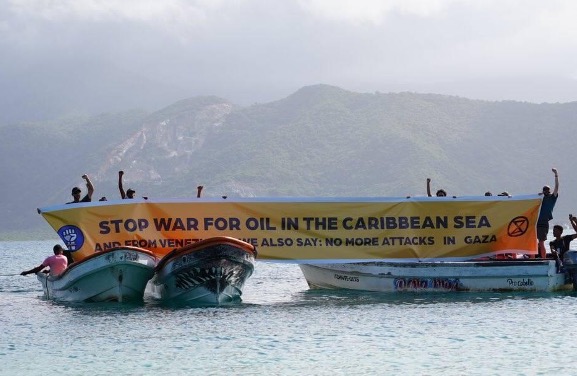
Photo: XR Venezuela
Dear rebel,
We look to the new year as a starting line, a time to take our futures where they are meant to go. But the first month of 2026 has felt less like an open road and more like a racetrack taking us back to where we’ve been. The United States’ actions in Venezuela, while illegitimate and aggressive, also demonstrate a nation repeating its history of extractivism and militarism. Meanwhile, other countries are experiencing a similar feeling of deja vu. In Scotland, investments made in the hope of augmenting wealth for individuals are in reality diminishing our ecosystems’ chances to thrive. In Argentina, mining companies seek growing profits at the expense of shrinking glaciers. We have seen all these narratives of greed before. It’s time to change direction.
To sustain climate action, we must surpass the short-lived burst of enthusiasm that the new year brings. We must remember the patterns of destruction that will stay strong unless we fight them every step of the way. We must remember that the paths taken to social and environmental health will vary depending on the community, but that our destination is the same. We must forget our tendencies to fight with our allies and focus instead on solidarity and community. No matter what our individual journeys towards a regenerative future look like—whether they involve growing healthy food, fighting legal battles, or marching in the streets—we must start now, and our pace must be steady and unyielding. If you’re wondering where and how to start, read on. There is plenty of room for you to walk beside us.
This newsletter is brought to you by XR Global Support, a worldwide network of rebels who help our movement grow and need money to continue this crucial work.
Action Highlight

Photo: XR Venezuela
Venezuela - XR statement
In response to the United States’ recent assault on Venezuela, XR Latin America prepared a statement of their official position, which is available here. The letter opens stating, “As a socio-environmental movement, we cannot remain silent in the face of the illegitimate and violent actions of the United States in Latin American territory.” The criminal Trump administration’s militaristic expansion of the U.S.’s reliance on fossil fuels by looting oil and resources from Latin America, most recently from Venezuela, highlights that the U.S. “has become the principal threat not only to Latin America, but to humanity as a whole, posing a direct danger to nature, biodiversity, and the planet itself.” XR Latin America’s letter concludes with a powerful call to action, urging socio-environmental movements to adapt their strategies in light of the rise of violent, fascist, and authoritarian capitalistic leadership. XR Rebels must resist this violent entrenchment of fossil fuel reliance and continue to fight for a healthy and safe future for our planet. Official Statement on Venezuela
Action Roundup
XRScotland - Strathclyde Pension Fund
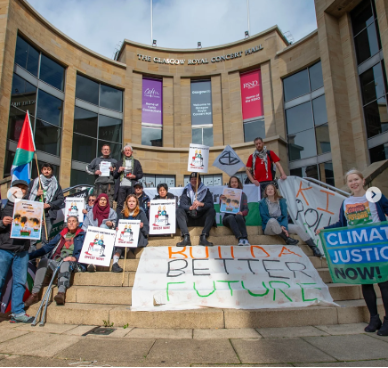
Image from XR Scotland
Scottish Rebels joined climate and trade union groups outside the Strathclyde Pension Fund’s 50th anniversary in Glasgow to express their anger and deep concern over how workers’ pensions are being invested. Holding an “unhappy birthday” protest, they highlighted the fund’s links to arms-related industries and called for an end to investments in some of the world’s biggest polluters (Shell, TotalEnergies, and Eni, to name a few) which are driving climate breakdown and contributing to the suffering of people in Gaza. Protesters appealed for compassion and accountability, urging the fund to divest from destructive industries and redirect money toward investments that respect human life and help build a fairer future for all. The Strathclyde Pension Fund invests over £400 million in fossil fuel companies. Read the full breakdown here.
Argentina - Glacier Law
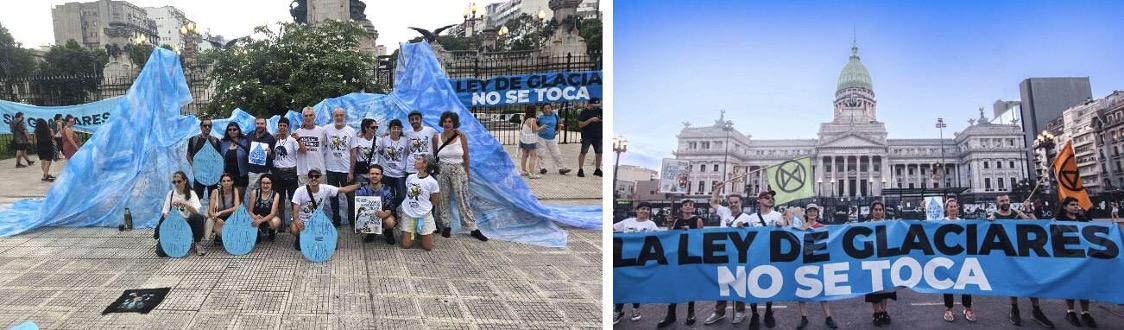
Image: XR Argentina
Although Argentina was the first country to implement legal protections for glaciers and periglaciers, the nation’s President Javier Milei recently proposed amendments to Congress that would allow mining, fossil fuel exploration, and industrial activity in glacial and periglacial areas. On December 4th and 22nd, XR Argentina carried out actions in front of Argentina’s Congress in protest of the proposed amendments. Protecting these glaciated areas is critical for the preservation of Argentina's most precious water ecosystem. Learn more about the actions here.
Positive News
Alaska Tests a Theory: Solar Farms Help Nearby Crops Grow
Alaska might seem an unlikely place for groundbreaking solar energy projects, but both food and energy are very costly there, and the northerly state’s natural gas deposits are running out, so innovation is key – and bi-facing (or bifacial) solar panels could be part of the solution. Researchers in the young science of agrivoltaics are studying whether the same land can be used to produce both food and energy. Their testing ground is Alaska’s largest solar farm, which generates power for 1,400 homes. Could edible crops be grown between the arrays of solar panels, creating a combined food/solar farm?
Apparently, yes. Firstly, those bi-facing solar panels catch winter sunlight reflecting off the snow onto their backside. This can account for thirty percent of the energy produced in some seasons. As for the plants, too much sunlight would harm them – and with the Arctic warming four times faster than the rest of the planet, researchers observed that plants grow bigger if they have some shade. Not only do the solar panels offer protection from solar stress, but they also hold heat that can extend the growing season. Although it’s currently unclear whether the federal government will continue funding the project for the full three years originally planned, the scientists are enthusiastic about results they’ve measured even with only one season of data.
Must Reads
Australia to offer three hours free solar per day to millions
Australia has announced a new federal energy initiative called the “Solar Sharer” scheme that will give households at least three hours of free solar-generated electricity each day during peak sunshine hours. This initiative will be implemented from mid-2026 in the states of New South Wales, South Australia, and southeast Queensland. The programme is led by energy minister, Chris Bowen and aims to help consumers cut their energy bills. Importantly, the free power will only be available to households with smart meters, so households that do not have their own rooftop solar panels are encouraged to request a smart meter, broadening access to the benefits of Australia’s solar boom. Additionally, the government hopes the scheme will shift overall electricity demand away from expensive evening peak periods while reducing pressure on the grid and potentially lowering costs for all users. Learn more here.
Quick Watch
Lost
The Red Rebels is a performance-art protest group which emerged from a UK branch of Extinction Rebellion, and is now expanding internationally. In this video, their unique and rousing approach to protest marks the World Biodiversity Loss Day, in mourning of species lost in our diminishing world. Cloaked in blood-red with painted faces, solemn expressions, and raised arms, their funeral-like procession through Ghent demands the attention of passersby. Through this colour, symbolism, and movement, their performance evokes an emotive response to the tragedy of biodiversity loss, and a deeper reflection on what threatened species still remain.
The fight against climate change has always been complex and multifaceted, and the enormity of its ambition to raise awareness of our dying world to people who don’t want to listen constantly demands new angles. Through their theatrical spin on protest action, the Red Rebels visually portray the abstract notion of loss, which is in its very nature invisible and intangible. The group captures the impacts of climate change which are not only damaging in a scientific and socioeconomic sense, but in a psychological one too. Any spectator can feel the stirrings of the rage, grief, and mourning of the climate crisis.
Book Review

Winners Take All: The Elite Charade of Changing the World
In 2020, Jeff Bezos launched the Bezos Earth Fund by pledging $10 billion to “fight climate change and protect nature” while Amazon, the company he founded and still owns 8% of, has been destroying the planet and driving climate change since 1994. This isn’t an anomaly – it’s the rule, as journalist and author Anand Giridharadas explains in his book, *Winners Take All: The Elite Charade of Changing the World.*
Although Winners Take All was written in 2018, the thesis is as urgent as ever: the people in power organize everything, including their philanthropy, to make sure they stay in power. Giridharadas explains that most philanthropic organizations in the world are based on principles outlined by robber baron Andrew Carnegie in 1889 in his essay “Gospel of Wealth”, namely that the rich have an obligation to society to “give back”. However, Carnegie ignored the fact that it was the industrialists’ capitalist exploitation that pushed people into poverty.
The current generation of tech billionaires has created a new “gilded age” in which the disparity between the wealthiest and the poorest has never been greater. And their so-called generosity is just another way to make sure the world doesn’t change.
Avoid Amazon. Support local bookshops in person when you can. Online buy your books at Bookshop or Hive(UK).
Dispatch from the UN
The Global Environment Outlook (GEO) is the UN Environment Programme’s flagship report on the state of the planet, published roughly every six years to guide global action on the environment. The seventh edition, GEO 7, released in December 2025, was produced by 287 experts from over 80 countries and delivers a very clear warning: climate change, biodiversity loss, pollution, and land degradation are accelerating, and our current development paths are driving the world toward ecological collapse.
The report also lays out urgent, actionable steps that could protect ecosystems and build a fairer and more sustainable future. Yet, according to the BBC, GEO‑7 was released without its usual “Summary for Policymakers”, after governments including the US, Russia, and Saudi Arabia couldn’t agree on the science and recommendations (such as calling for a rapid phase-out of fossil fuels and major cuts to harmful subsidies). This bureaucratic deadlock could weaken the report’s urgent message, leaving those with the power to act unaware of the crisis unfolding. Meanwhile, communities and ecosystems around the world continue to suffer, reminding us that inaction has real human and environmental costs. Read the full GEO-7 Report here
Worth a Second Look

How to have a conversation with a climate change sceptic
Have you ever felt the frustration of dealing with a blatant climate change denier? How to have a conversation with a climate change sceptic offers us a quick guide to consult the next time you encounter one of these difficult interactions. Although compassion may not be the first emotion you feel surge within, author Nikki suggests reacting with compassion over judgement. It may be difficult for the average citizen to understand the severity of the climate crisis we are facing, when the world appears to remain so unnervingly calm. Our governments steer clear of words like “emergency” and “crisis”, instead framing climate change as a “debate”. The media fabricates the impression that climate change is still a distant problem, one for future generations. For now, it is simply easier to deny that we all live in a house on fire.
This intentional ignorance from world leaders is a major hurdle to widespread recognition of the climate crisis, paired with the murky waters of false information in the age of the internet, where a voice is given to self-proclaimed professionals, and legitimate fact-checking is too often neglected. Interpreting climate change through politicians and media is more often an exercise in smoke and mirrors, yet scientific journals consistently prove the abnormality of global temperature rise and extinction rates with terrifying clarity. This XR blog post provides clear, scientifically-backed responses to common myths which people may use to shield themselves from the distressing truth of the state of our planet.
Stand with the Global South - Power the Rebellion
We Love to Hear From our Readers
Please email us at: xr-newsletter@protonmail.com
P.S. Forward this newsletter to a friend. If this was forwarded to you, join us and subscribe to the XR Global Newsletter.