Image: Scientist Rebellion
Dear rebel,
The world collectively exhaled late on the night of November 3rd and allowed itself one long moment of joy and relief. The people do have power, and it was encouraging to see that this time, money didn’t equal votes. Even when it was fossil fuel money. Inspiring winners like Scott Colom and Keisha Lance Bottoms proved that change is possible.
We woke up on the 4th energised and ready to get back at it. For ten years, UN Secretary General Antonio Guterres has campaigned hard for the planet as a fierce critic of the fossil fuel industry. His second term ends in December and at COP31 this month in Turkey, Guterres told attendees, “You cannot build peace on a burning planet.” Expectations for a meaningful COP are low while the importance of having another climate champion at the UN is high.
From Sweden to South Africa, XR rebels never slow down. If you can, show your support with a donation this month.
This newsletter is brought to you by XR Global Support, a worldwide network of rebels who help our movement grow and need money to continue this crucial work.
Action Highlight
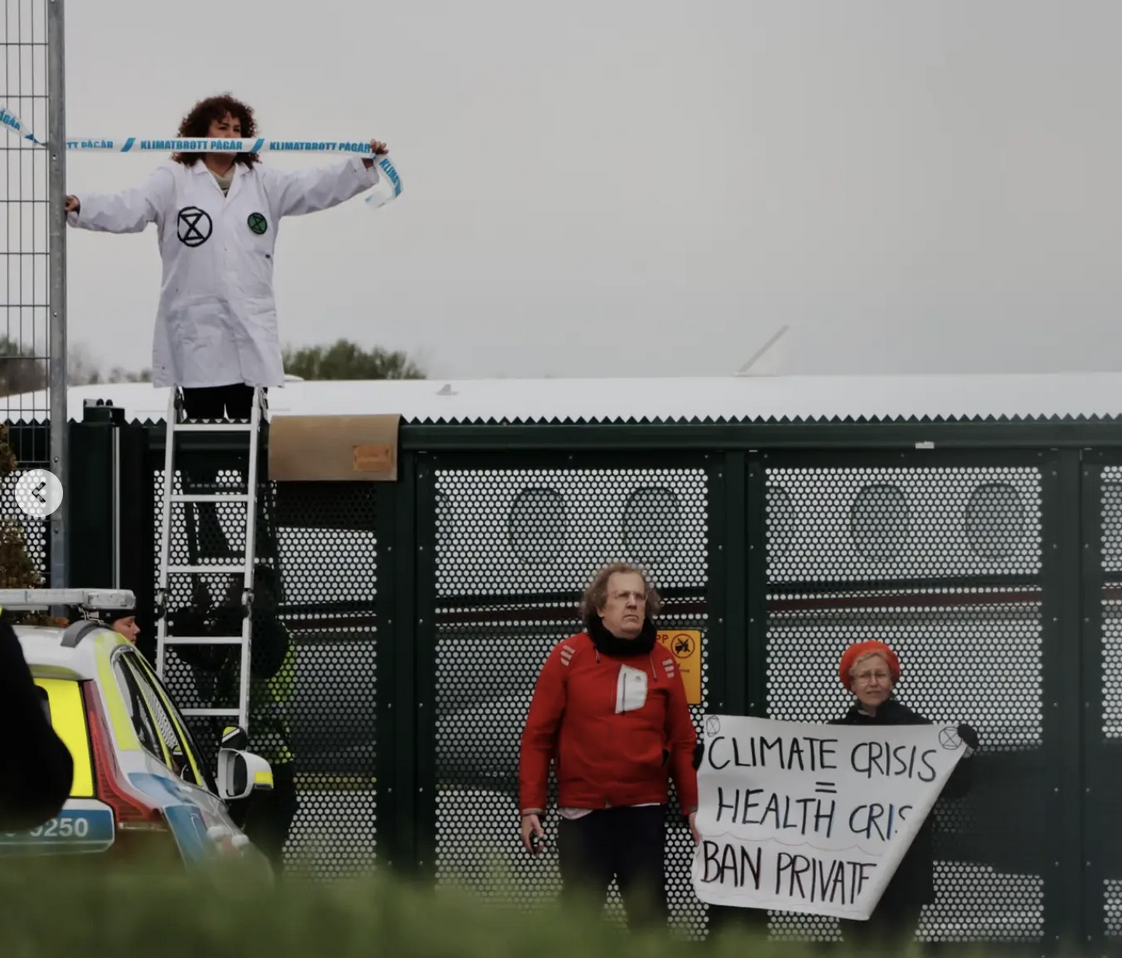
Photo: Scientist Rebellion
October 2026 | XR Sweden
BAN PRIVATE JETS!
On October 10th, Scientist Rebellion and XR Sweden staged a protest and blockade at Bromma Airport. The action targeted the Grafair terminal, which is exclusively for private jets and therefore serves a miniscule minority, the financial elite who choose to travel in the most damaging possible way.
Rebels gained access to the runway and surrounded a plane, whilst a demonstration took place outside. Five arrests were made. The protest called for a ban on private jets; our fragile climate is already strained by the expanding labyrinth of commercial flight paths which weaves itself over our heads 24 hours a day, 365 days a year. It is unacceptable that some of these journeys to transport only one or two people from A to B release such a high amount of greenhouse gases.
Transport by private jet appertains to a lifestyle which is inaccessible to most yet consequential in the extreme. The rich are the highest driver of rising CO2 emissions out of any social group, yet it is the poorer members of our society who are impacted most. It is much easier to ignore rising temperatures, floods, and droughts from the confines of an air-conditioned mansion, yet it won’t be long until even money can’t save us from the impending repercussions of our warming planet. Hold the rich accountable for their actions and ban private jets. Follow Scientist Rebellion and Extinction Rebellion Sweden.
Action Update
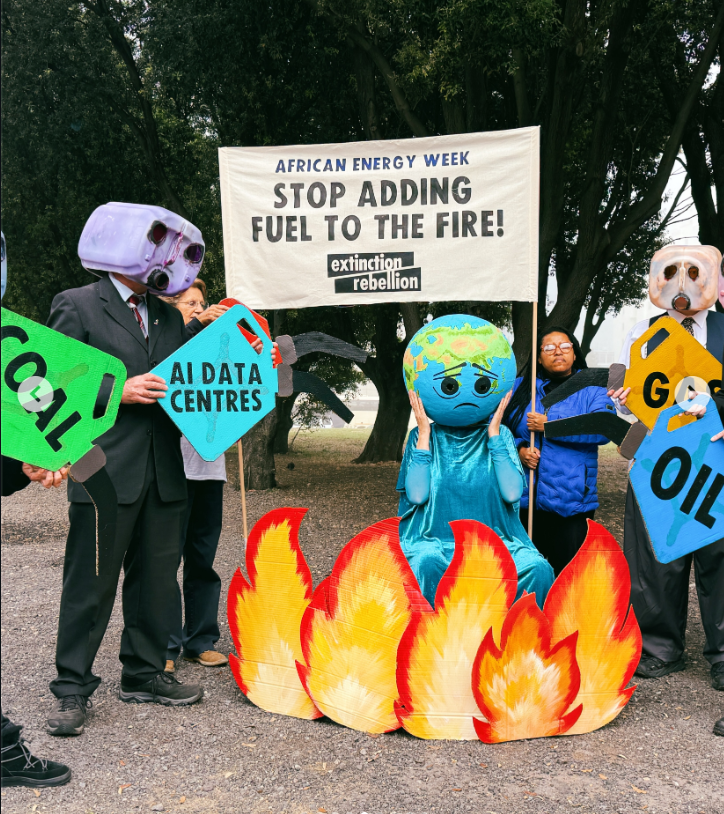
Photo: Extinction Rebellion South Africa
October 2026 | XR South Africa
“No More Fuel on the Fire”: South African Rebels Take On African Energy Week
While more than 10,000 people attended African Energy Week in Cape Town, South African Rebels and Greenpeace activists stood outside with a simple message: no more coal, oil or gas. They called on the government to shift policy and back a massive rollout of sustainable energy. Inside, it was business as usual. Chevron and ExxonMobil reaffirmed their commitment to African exploration, while national oil companies signed a declaration to work even more closely together. The sponsor list says it all: ExxonMobil, Sonangol, Chevron, TotalEnergies, bp, ADNOC and Shell, all backing the event.
Then came the week’s shiny new feature, an AI and Data Center Track, which sells power-hungry data centres as yet another excuse to build far more power generation. South Africa is already leading the charge with this, but who is counting the cost to the country’s water, grid and climate? See more and follow ExtinctionRebellionSA.
Positive News
‘We wanted to prove we didn’t need air conditioning’: the airport cooled by natural ventilation - Guardian
In airport terminals, heating, ventilation, and air conditioning can account for roughly 40 to 60 per cent of total energy use. That makes cooling the biggest energy-saving opportunity, and one airport on Réunion Island is already making the most of it. The arrivals terminal at Roland Garros Airport runs without air conditioning and relies on natural ventilation instead; its curved roof guides the tropical breeze through adjustable vents. Summer heat is often around 30C, but the airflow makes the building feel four to five degrees cooler.
Thousands of kilometres away in southern India, Kochi’s Cochin International Airport took a different route. In 2015 it became the world’s first airport to produce all the power it needs from solar energy. It has kept expanding its solar capacity since, with a newer plant aimed at making it power-positive, and the UN has recognised it with a Champions of the Earth award. Sometimes the best energy solutions come from what’s already around us, like a good breeze and a lot of sunshine!
Must Reads
Map Shows Nations Urging People to Stockpile Food as France Issues Warning - Newsweek
More and more countries are recommending that their citizens stockpile basic goods, but it is important to go beyond that, to build community and to think about what a better, more just future would look like. XReadiness is an online, free downloadable booklet with clear checklists and easy to follow sections. It will help you to prepare physically with specific suggestions (in contrast to vague government warnings) but also includes many ideas for getting to know your neighbours and working on skills that can be essential in a crisis. Check out XReadiness here.
This Month's Suggested Action
Since electoral politics is on everyone's mind, this seems like a good moment to suggest that you get involved--locally. While the details vary depending on where you live, it's quite possible that a lot of decisions relating to climate action are actually made by people elected at the local level. For example, community planning and zoning, public health and emergency response, law enforcement and justice, and education all relate to the fight against climate change in one way or another.
Can you run for office yourself? Can you find local candidates to support who can and will fight for climate sanity and justice? Or how about starting by identifying locally-elected offices that are or could become relevant? You can then follow up by learning about who serves in those positions and who might want to serve in them in the future.
Getting climate-sane people into local office is very important--and local office can be the first step towards national office, too.
Ancestors of XR
Ursula K. Le Guin

Photo credit: Marion Wood Kolisch, 1988 / Courtesy Portland Art Museum
American writer Ursula K. Le Guin is best known for her original speculative and science fiction of the 1960s and ’70s, which influenced early environmental thinking.
Le Guin was born to anthropologist parents in Berkeley, California, in 1929. Her father's research included studying the last surviving member of the Yahi people. Ursula enjoyed reading Native American legends and Norse mythology, and her father’s research gave her an insight into “otherness” and how it helps us define the boundaries of our own selves. She grew up questioning Western assumptions about civilisation and was interested in science fiction from an early age.
After attending the same high school as science fiction writer Philip K. Dick (although the two didn’t know each other), she studied French at Harvard and Columbia before a Fulbright Award took her to France from 1953 to 1954. When she married, she gave up her doctoral studies and had three children, fitting her writing schedule around her family’s needs. She began writing full-time in the late 1950s and achieved major critical and commercial success with a series of works of speculative fiction. Her best-known works include her masterpieces A Wizard of Earthsea (1968) and The Left Hand of Darkness (1969). These novels challenged the social structures and assumptions underpinning hierarchy, colonialism, and limitless growth and the exploitation of the natural world, showing how these systems contribute to the ecological crisis.
Le Guin cited The Lord of the Rings author J.R.R. Tolkien among her stylistic influences and often subverted familiar fiction tropes, for instance by making dark-skinned protagonists the heroes. Rather than treating the natural world as a mere backdrop, Le Guin’s stories recognise humanity’s dependence on living systems. Decades before “climate fiction” became a major genre, she was already imagining sustainable, non-exploitative futures built around reciprocity and respect for ecological limits. One of her best-known works, The Lathe of Heaven (1971), is set in a polluted, overcrowded future marked by global warming, food shortages, and social breakdown. The story explores the dangers of trying to engineer a perfect world through technological and authoritarian intervention.
Le Guin’s legacy for today’s environmental movement isn’t a direct political programme but a shift in perspective: we must first be able to imagine a world organised differently before we can bring an alternative future into existence. She was also a strong critic of corporate control over publishing, resigning from the Authors Guild in 2009 over its support for Google’s book-digitisation project and condemning Amazon’s growing stranglehold on the industry. Ursula K. Le Guin died in 2018, aged 88. At her memorial, fellow novelist Margaret Atwood paid tribute to a writer who showed how ecological destruction is rooted in the way societies are organised, and who imagined radically different ways of living with the natural world.
Book Review
New England Weather New England Climate by Gregory A, Zeilinski and Barry D. Keim
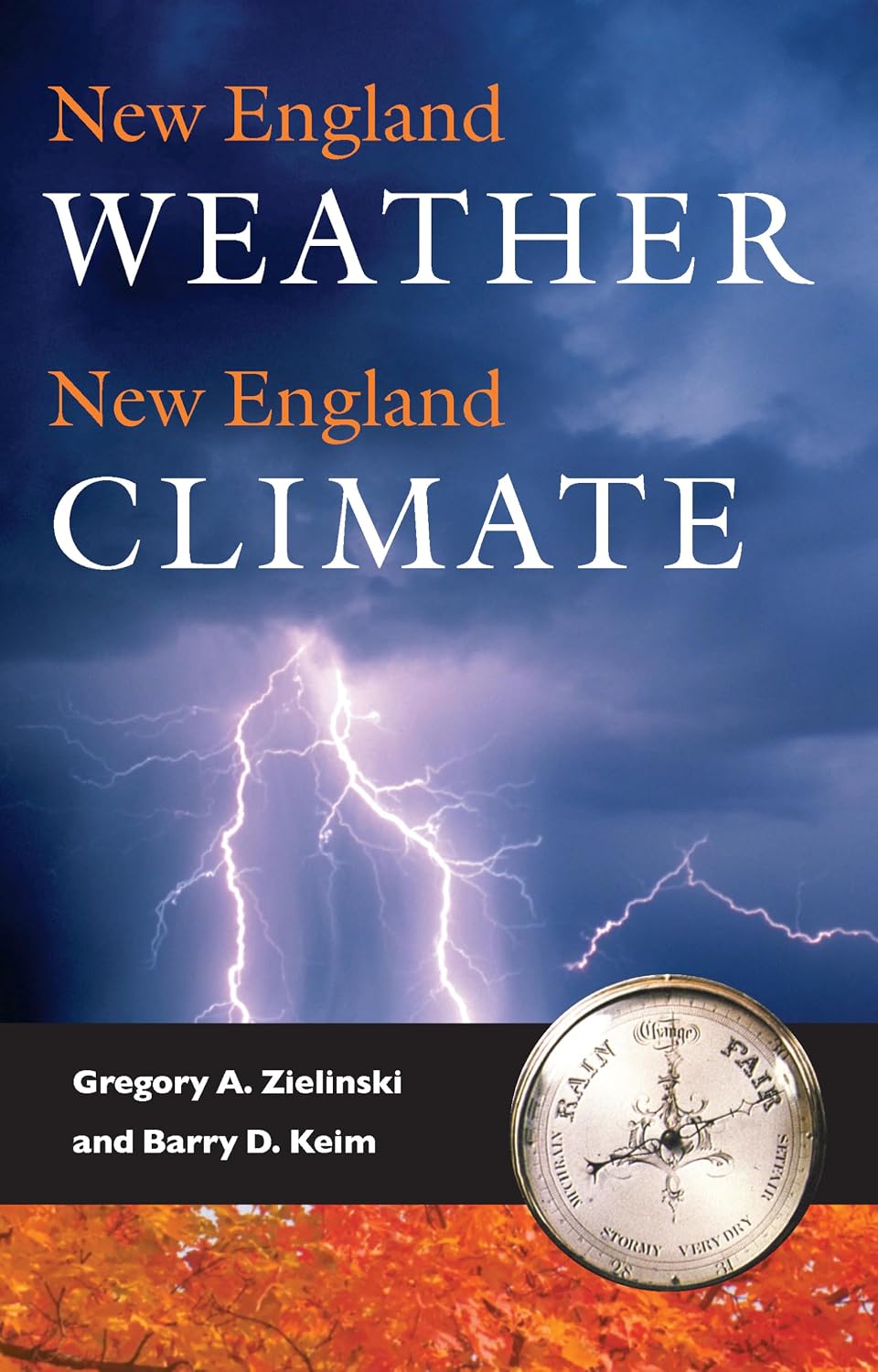
While it's true that most readers of this newsletter probably do not live in New England, it's far easier to wrap one's head around atmospheric complexity if you don't try to tackle the entire atmosphere at once. The New England region of the United States makes a fine introductory example whether you've ever been to New England or not.
This book is not about climate change per se, but discussions about climate change and its impact on weather will make more sense if one has a basic understanding of how the atmosphere works generally, and Zielinski and Keim do a good job of presenting the basics in enough detail to educate but not so much as to overwhelm an interested beginner with a good general education.
Readers should keep the publication date of 2005 in mind, as there are places where the material could be dated. And even for 2005, the authors' somewhat dismissive treatment of anthropogenic climate change (they do accept it as real) is puzzling and concerning. But for making clear some of the complexities that more recent publications tend to leave out, the book is well worth a read.
Must Watch
The Top 250 Documentaries We Can Use to Change The World | Tim Hjersted
What if changing the world begins with changing what we know about it?
Documentaries have a unique way of bringing realities to the surface, challenging what we have come to accept and giving visibility to stories that are often overlooked or unheard. From environmental justice and climate change to inequality, human rights, politics and social movements, these films offer an opportunity to learn, question and engage more critically with the world around us. The Top 250 Documentaries We Can Use to Change the World by Tim Hjersted is a collection worth exploring for anyone interested in understanding the challenges shaping our societies and the possibilities for creating meaningful change. Sometimes, all it takes is one documentary to challenge a perspective, spark a conversation or inspire someone to take action. Do not just watch to be informed. Watch to question, reflect and be inspired to make a difference.
Readers!
We’d like to hear from you! Please email us at: xr-newsletter@protonmail.com. Forward this newsletter to a friend. If this was forwarded to you, join us and subscribe to the XR Global Newsletter. If you have any questions or feedback, we want to hear from you. Get in touch at xr-newsletter@protonmail.com
P.S. Want to take action?Make a donation to help power the rebellion!